
Innovative Changes by Young Designer Entrepreneurs in the Korean Fashion Industry
Abstract
The global expansion of the Korean Wave (Hallyu) has reshaped international perceptions of Korean style, positioning K-fashion and K-beauty as significant cultural and industrial forces rather than just one-dimensional aesthetics. Young Korean fashion designers are driving innovation through entrepreneurial practices that integrate creativity, digital communication, and alternative business models. This study examines how young K-fashion designers are transforming the contemporary fashion industry and proposes a typology of startup-oriented business models based on their entrepreneurial, platform-based, and production strategies. It employs a qualitative multiple-case study design to analyze 30 Korean designer brands launched from 2020 to 2023, focusing on product and visual characteristics, brand management systems, and market entry strategies. The findings identify three dominant types of young Korean designer brands. The first type, traditional creative designer brands, emphasizes artistic authorship, craftsmanship, and small-batch or made-to-order production. The second type, market-oriented designer brands, features fandom-based marketing, digital-native communication, drop-based distribution systems, and rapid sales growth. The third type, eclectic designer brands, strategically balances artistic identity with commercial viability by integrating distinctive visual identity with market responsiveness. These findings indicate that K-fashion’s current competitiveness stems from various entrepreneurial approaches tailored to digital cultural markets.
Keywords:
Korean Wave (Hallyu), young designer, entrepreneurs, K-fashion, innovativeI. Introduction
The global diffusion of the Korean Wave (Hallyu) has significantly reshaped the international cultural and creative industries, positioning Korean fashion as an increasingly influential yet complex phenomenon. While early academic and popular discourse often framed K-fashion as a derivative extension of K-pop and K-drama aesthetics, recent developments reveal a far more heterogeneous ecosystem composed of diverse designer identities, entrepreneurial practices, and digitally mediated consumption cultures (Jin, 2016; Oh & Park, 2012). Rather than representing a monolithic style, contemporary K-fashion operates as a dynamic field in which creativity, commerce, and cultural symbolism intersect and are continuously negotiated. Within this broader cultural landscape, K-fashion and K-beauty have emerged as core industrial pillars of the Korean Wave, contributing not only to cultural visibility but also to export growth and national branding strategies (Kwon & Kim, 2014). However, the global fashion industry is currently facing heightened uncertainty due to economic slowdown, persistent inflation, supply chain disruption, and geopolitical instability (McKinsey & Company, 2026). Under these volatile conditions, the resilience and adaptability of young Korean designer brands many of which operate as micro scale enterprises have attracted growing academic and policy attention.
Recent industry reports provide critical empirical context for understanding this structural transformation. According to the 2024 Designer Fashion Industry Status Survey, the Korean designer fashion market reached an estimated size of approximately KRW 1.36 trillion in 2023, indicating a strong recovery following the COVID19 downturn and signaling long term growth potential (Korea Creative Content Agency [KCCA], 2025). Despite this quantitative growth, the industry remains structurally fragmented: 44.7% of designer fashion firms are less than five years old, and 75.9% operate as sole proprietorships, underscoring the dominance of micro scale entrepreneurial models rather than corporatized fashion enterprises (KCCA, 2025). At the operational level, young designer brands exhibit a pronounced digital orientation. Online channels account for 72.6% of domestic sales, with fashion platforms and proprietary online stores serving as primary distribution mechanisms (KCCA, 2025). Marketing practices further reflect this shift, as 89.1% of brands actively manage their own websites or social media accounts, while more than half collaborate with influencers and digital content creators as part of their branding strategies (KCCA, 2024). These trends indicate that contemporary Korean designer brands function not merely as design-centered entities but as hybrid organizations that integrate creative production, digital communication, and direct to consumer (D2C) engagement.
Despite high global favorability toward Korea and K-brands, brand-level recognition and actual purchase experience remain comparatively low, revealing a structural gap between cultural visibility and market conversion (KCCA, 2025). In response, policy driven initiatives have increasingly focused on digital transformation, small batch and on demand production systems, intellectual property protection, and the development of global B2B platforms. Within this framework, young designer brands are no longer positioned as peripheral creative actors but as key agents of industrial renewal in the Korean fashion ecosystem (KCCA, 2025). A longitudinal comparison further highlights the magnitude of this shift. Earlier studies of emerging Korean designers emphasized constraints related to limited manufacturing access, capital scarcity, and heavy dependence on physical retail channels (DeLong, 2015). In contrast, the current ecosystem is characterized by platform-based visibility, influencer mediated cultural circulation, and the presence of brand building intermediaries that enable designers to bypass traditional gatekeepers and experiment with alternative growth trajectories. Consequently, the core competency of Korean fashion designers has expanded beyond individual creative authorship to encompass entrepreneurial orchestration across design, communication, and business systems.
Against this backdrop, this study examines how young Korean fashion designers are transforming the contemporary fashion market through entrepreneurial practices. Specifically, the study aims to: (1) identify patterns of change among designer brands that have achieved global visibility; (2) derive a conceptual framework of startup oriented business models within K-fashion; and (3) explore the competencies required of future fashion entrepreneurs, along with policy implications for fostering emerging designer talent in an increasingly digital and volatile global fashion environment.
Ⅱ. Literature Review
1. Designer Fashion Brands and Creative Industries
Designer fashion brands are commonly understood as designer-led enterprises in which creative authorship and brand identity are closely associated with an individual designer or a small creative team (Aspers & Godart, 2013). Unlike luxury conglomerates or fast fashion corporations, designer brands typically operate with limited financial resources, small production volumes, and a strong dependence on symbolic and cultural capital rather than economies of scale (Aspers & Godart, 2013; Bourdieu, 1993). As a result, their competitiveness is closely tied to the designer’s creative vision, aesthetic coherence, and the ability to translate symbolic value into market recognition. Within creative industries research, fashion is conceptualized as both a cultural and an economic system, in which value is generated through aesthetic innovation, narrative construction, and symbolic differentiation (Crane, 2012; Entwistle, 2009). From this perspective, designer fashion brands function as cultural producers that contribute to meaning-making processes while simultaneously engaging in commercial exchange. Their products operate not only as functional garments but also as carriers of identity, distinction, and cultural narratives.
In the context of globalization and digital transformation, the position of designer fashion brands within creative industries has undergone significant change. Digital platforms, social media, and online marketplaces have reconfigured traditional gatekeeping structures, enabling designers to communicate directly with consumers and experiment with alternative modes of brand-building (Arvidsson & Bonini, 2015). This shift has expanded the role of designers beyond creative authorship to include storytelling, community engagement, and entrepreneurial orchestration. Within the Korean context, these dynamics are particularly salient. Earlier studies of Korean designer brands emphasized structural limitations related to manufacturing access, capital scarcity, and dependence on physical retail channels (DeLong, 2015). However, recent transformations suggest that designer fashion brands in Korea are increasingly embedded in digitally mediated creative ecosystems, where symbolic capital is produced and circulated through platforms, influencers, and participatory consumption cultures. This evolving landscape necessitates a reexamination of designer fashion brands not merely as creative entities but as adaptive actors within contemporary creative industries.
2. Entrepreneurial Designers and Cultural Entrepreneurship
Entrepreneurship in fashion extends beyond firm ownership to encompass opportunity recognition, innovation, and cultural meaning-making (Fillis & Rentschler, 2010; Rae, 2007). Rather than focusing solely on organizational formation or financial growth, fashion entrepreneurship involves the continuous translation of creative ideas into marketable products while maintaining cultural legitimacy and symbolic value (Scott, 2012). In this context, designers frequently assume the role of cultural entrepreneurs, operating simultaneously as creators, brand managers, and communicators. The concept of cultural entrepreneurship emphasizes how creative actors mobilize cultural resources, narratives, and identities to construct value within markets characterized by uncertainty and symbolic differentiation (Lounsbury & Glynn, 2001; Swedberg, 2006). For designer-led fashion brands, entrepreneurial activity is inseparable from creative authorship, as designers are directly responsible for both aesthetic innovation and strategic positioning. This dual responsibility differentiates designer-entrepreneurs from traditional business entrepreneurs and situates fashion entrepreneurship within the broader discourse of creative industries.
Recent studies have highlighted the rise of “designer-entrepreneurs” who integrate creative practice with business strategy, particularly within digitally mediated environments (Nixon & Crewe, 2004). Due to the small scale and resource constraints of many designer fashion brands, designers often perform multiple organizational roles, including product development, branding, marketing, and consumer communication. This concentration of roles intensifies the entrepreneurial demands placed on designers and requires competencies that extend beyond technical design skills. Digital platforms have fundamentally reshaped the entrepreneurial landscape of fashion. Social media and platform-based ecosystems enable designers to bypass traditional gatekeepers such as buyers, editors, and physical retailers, allowing for direct engagement with consumers and the construction of brand narratives through visual, affective, and interactive communication (Nieborg & Poell, 2018). Through these platforms, designer-entrepreneurs can cultivate communities, activate fandom, and experiment with alternative business models such as direct-to-consumer (D2C) sales, limited drops, and participatory branding.
In the Korean fashion context, these dynamics are particularly pronounced. Earlier research on emerging Korean designers emphasized structural constraints, including limited manufacturing access, capital scarcity, and dependence on offline retail infrastructures (DeLong, 2015). However, recent industry developments suggest a shift toward digitally enabled cultural entrepreneurship, in which young designers strategically leverage platforms, influencers, and storytelling to achieve visibility and market traction. This transition reflects a broader redefinition of the designer’s role from an autonomous creative author to an entrepreneurial orchestrator operating at the intersection of culture, technology, and commerce. By conceptualizing young Korean fashion designers as cultural entrepreneurs, this study contributes to an expanded understanding of fashion entrepreneurship that foregrounds creativity, symbolic production, and digital mediation. This perspective provides a critical foundation for analyzing how K-fashion designers construct sustainable business models and navigate global markets under conditions of heightened uncertainty and rapid technological change.
3. Digital Platforms, Fandom, and micro-brands
Digital platforms have fundamentally altered the modes of fashion production, circulation, and consumption. Social media platforms such as Instagram and TikTok, alongside fashion e-commerce platforms, now function as cultural intermediaries that shape taste formation, visibility, and market access (Abidin, 2016; Duffy & Hund, 2019). Unlike traditional fashion media or retail systems, these platforms operate through algorithmic logics and participatory communication, enabling designers to directly engage with audiences while simultaneously influencing how fashion value is produced and perceived. Within this platformized fashion ecosystem, fandom-based consumption has emerged as a key mechanism of brand growth. Previously associated primarily with popular music, television, and celebrity culture, fandom has increasingly influenced fashion branding, particularly in East Asian markets where participatory media cultures are deeply embedded (Jenkins, 2006). In fashion contexts, fandom refers to affective communities formed around brand narratives, designer personas, and shared aesthetic values, rather than around individual products alone. Through sustained interaction, fans contribute to the circulation of symbolic meanings and act as informal promoters of designer brands.
The rise of micro-brands exemplifies this structural transformation. micro-brands often operating as one person or small team enterprises leverage digital platforms to compensate for limited financial and manufacturing resources. Their agility, perceived authenticity, and narrative-driven branding resonate strongly with younger consumers who seek individuality, emotional connection, and alignment with personal identity (Khajeheian, 2020). Instead of pursuing scale through mass production, micro-brands frequently adopt strategies such as limited drops, direct-to-consumer (D2C) sales, and continuous storytelling to cultivate loyal consumer communities. Korean designer brands provide a particularly salient case through which to examine these transformations. In the Korean fashion industry, micro-brands have proliferated within a highly digitalized cultural environment shaped by K-pop, social media fandom, and influencer-driven consumption. Designers actively utilize platforms to construct visual narratives, engage fans through interactive content, and maintain ongoing communication that blurs the boundary between production and consumption. This platform-based, fandom oriented model has enabled young Korean designers to achieve rapid visibility and market traction despite structural constraints traditionally associated with small scale fashion enterprises.
Collectively, the convergence of digital platforms, fandom based consumption, and micro brand entrepreneurship represents a significant departure from earlier fashion industry models reliant on physical retail, seasonal cycles, and institutional gatekeepers. Contemporary designer brands increasingly operate within participatory fashion ecosystems in which cultural production, consumption, and promotion are deeply intertwined. Understanding this configuration is essential for explaining how young Korean designers navigate global competition, construct sustainable business models, and redefine the creative and economic logics of K-fashion in the digital age.
4. Platformized Cultural Markets and Value Conversion Mechanisms in K-fashion
Recent studies in cultural industries and media economics emphasize that contemporary creative markets are increasingly structured through processes of platformization, whereby digital platforms function not merely as channels of promotion or distribution but as infrastructural systems that reorganize how cultural value is created, circulated, and monetized (Helmond, 2015; Nieborg & Poell, 2018). Within such platformized cultural markets, visibility, algorithmic mediation, and affective engagement operate as key determinants of economic viability. Fashion, as a symbolic and highly image-driven industry, is particularly susceptible to these dynamics. In the context of K-fashion, platformization has played a decisive role in reshaping the relationship between creativity and commerce. Unlike traditional fashion systems where value conversion was mediated by institutional gatekeepers such as buyers, editors, or luxury conglomerates contemporary Korean designer brands increasingly rely on platform-based mechanisms to translate symbolic capital into market value. Social media platforms, fashion e-commerce sites, and influencer ecosystems function as cultural intermediaries that convert creative authorship into measurable forms of attention, engagement, and community participation (Bourdieu, 1993).
This process of value conversion in K-fashion operates through multiple, interrelated stages. First, creative authorship generates symbolic capital through distinctive design languages, aesthetic coherence, and culturally resonant storytelling. This dimension remains central across all designer brand types identified in this study, underscoring the continued importance of creativity as the foundational asset of designer-led enterprises. Second, platform-based communication transforms symbolic capital into visibility by circulating images, narratives, and designer personas through algorithmic systems. Here, engagement metrics such as likes, shares, comments, and follower networks function as proxy indicators of value, shaping both consumer perception and commercial opportunity. Third, fandom mediated participation plays a critical amplifying role in the Korean fashion ecosystem. Drawing on the participatory consumption cultures established through K-pop and digital media, K-fashion brands increasingly cultivate affective communities that actively contribute to meaning making, brand advocacy, and symbolic reinforcement (Jenkins, 2006). Rather than positioning consumers as passive buyers, young Korean designer brands mobilize fandom as a value generating force, where emotional attachment, identity alignment, and community belonging directly support repeated consumption and brand diffusion.
Finally, flexible production and distribution systems enable designers to respond adaptively to platform generated signals. Small batch manufacturing, on-demand production, drop based releases, and hybrid online offline distribution structures allow micro scale brands to minimize risk while maintaining responsiveness to fluctuating demand. These adaptive systems are particularly salient in K-fashion, where many young designer brands operate as micro-enterprises under conditions of capital constraint and market volatility. By situating K-fashion within the broader framework of platformized cultural markets, this study extends existing discussions of cultural entrepreneurship and fashion business models. It demonstrates that innovation among young Korean designer brands is not limited to aesthetic novelty or digital tool adoption, but is fundamentally structural emerging from new mechanisms of value conversion that link creativity, platforms, and micro-entrepreneurial organization. This theoretical perspective provides a critical foundation for the innovative business model framework proposed in the Discussion section and clarifies how K-fashion operates as a distinctive yet globally relevant cultural industry in the digital age.
Ⅲ. Research Methodology
This study adopts a qualitative multiple-case study design to examine innovative business model transformations among young Korean designer brands. Case study research is particularly appropriate for exploring complex, context dependent phenomena such as creative entrepreneurship, where industry structure, cultural meaning, and market practices intersect (Yin, 2018). Through systematic cross-case comparison, the study aims to identify recurring patterns and develop an empirically grounded understanding of designer-led business models within the Korean fashion industry.
1. Case Selection and Sampling Strategy
This study employed a theory informed, stratified case selection strategy. Based on the theoretical framework developed in the literature review drawing on research on designer fashion brands, cultural entrepreneurship, platformized markets, and micro brand dynamics three analytical categories were defined as guiding constructs: traditional creative designer brands, market oriented designer brands, and eclectic designer brands.
These categories function as analytical lenses rather than rigid classifications. A stratified sampling approach was used to ensure balanced representation across the three categories, with ten brands selected in each group, resulting in a total sample of 30 young Korean designer brands. Brand selection was conducted using a structured procedure within predefined strata, rather than convenience sampling.
To construct the sampling frame, multiple sources were referenced, including: (1) designer brands frequently visible on fashion platforms and consumer oriented rankings, (2) brands actively circulating through Instagram and other social media channels, reflecting platform-based promotion and digital native distribution practices, and (3) designer brand lists and industry reports referenced in institutional surveys and policy documents.
Brands were included if they met the following criteria: (1) launch and active operation between 2020 and 2023, (2) sustained market activity beyond the initial launch phase, (3) visible digital presence through official websites and/or social media platforms, and (4) engagement with domestic or international fashion markets through platforms, pop-up retail, exhibitions, or distribution partnerships.
2. Data Sources and Analytical Procedure
This study conducted a systematic case-based analysis of 30 young Korean designer brands selected through a theory-informed, stratified sampling strategy. The analysis relied exclusively on publicly accessible secondary data, ensuring transparency and replicability.
Multiple data sources were triangulated to capture design orientation, business strategy, and platform-based practices. These included: (1) official brand websites, providing information on brand identity, product categories, pricing, and distribution; (2) social media platforms, particularly Instagram, used to analyze visual communication, content frequency, influencer collaboration, and fandom engagement; (3) fashion e-commerce platforms, offering insights into sales formats and product turnover; and (4) fashion media and industry reports, contextualizing brand positioning and market visibility. These materials were treated as empirical data reflecting actual market practices rather than promotional content.
Analytical dimensions were derived from the theoretical framework established in the literature review. Each brand was examined across four dimensions: (1) creative authorship and design orientation; (2) production and scalability strategies; (3) platform-based communication and distribution; and (4) market engagement logic. Cross-case comparison was conducted both within and across the three analytical categories traditional creative, market oriented, and eclectic designer brands to identify recurring patterns and structural variation.
The typology was informed by prior theoretical constructs and refined through cross-case analysis. Rather than being arbitrarily assigned, brand classification was based on dominant patterns observed across multiple dimensions, allowing the study to examine how ideal typical configurations are manifested in contemporary Korean designer fashion practice.
To ensure analytical consistency, each dimension was operationalized using observable indicators derived from publicly available data, including product structure, platform activity frequency, distribution channels, and price positioning. Classification was determined by aggregated patterns rather than single indicators, enabling a systematic and comparative interpretation across cases.
VI. Results
This section presents the empirical findings based on a systematic case based analysis of 30 young Korean designer brands including brands launched between 2020 and 2023, ensuring sufficient operational continuity for analysis. In contrast to industry level surveys, the analysis focuses on brand level configurations of design orientation, production systems, platform use, and market strategies. Three dominant types of young Korean designer brands were identified, each reflecting distinct entrepreneurial logics, production systems, and modes of platform engagement.
1. Typology of Young Korean Designer Brands
The 30 designer brands analyzed in this study were identified from a consolidated population of young Korean designer brands registered with national fashion related organizations (e.g., Korea Fashion Industry Association, Korea Fashion Designers Association), fashion platforms, and major domestic fashion media between 2020 and 2023. Brands were selected according to three criteria:
- (1) independent brand operation led by a designer or small creative team;
- (2) continuous market activity for more than two years; and
- (3) visible engagement with online platforms and public facing brand communication.
For each brand, data were collected from multiple sources, including official brand websites, Instagram accounts, online fashion platforms, press coverage, and where available corporate disclosures or public business reports. These materials were analyzed using a comparative content analysis approach, focusing on five dimensions: design orientation, production system, distribution channels, platform and fandom engagement, and price positioning. Rather than being rigidly assigned to predefined categories, the typologies were informed by theoretical constructs and refined through cross-case comparison. Recurrent patterns observed across the 30 cases were used to elaborate and differentiate the three analytically distinct brand types. All brands were classified into one of these three types, ensuring full coverage of the dataset.
Traditional creative designer brands are characterized by a strong emphasis on artistic authorship, craftsmanship, and cultural value. Among the 30 brands analyzed, Mina Chung, Kow.gi, Painters, and Jaden Cho were consistently classified within this category based on their design orientation, production systems, and market strategies. Empirical analysis of brand websites, Instagram content, and press interviews indicates that Mina Chung primarily operates through small-batch seasonal collections that emphasize handcrafted details and conceptual narratives rather than trend-driven items.
In terms of product and visual characteristics, traditional creative brands emphasize sculptural silhouettes, experimental material usage, and handcrafted construction details. Collections frequently feature oversized coats and jackets with layered structures, asymmetrical cutting lines, and non-standardized proportions that challenge conventional garment forms. Material choices often include unconventional or artisanal textiles, reinforcing a strong sense of creative authorship. Product structures are typically collection-oriented rather than item-repetitive, with limited reliance on standardized best-selling items. Styling and visual presentation are aligned with editorial or artistic imagery rather than commercial product display, maintaining a high level of conceptual coherence across collections.
Product descriptions and visual archives reveal a consistent focus on textile experimentation and artisanal finishing, with relatively limited product variation per season. Similarly, Kow.gi demonstrates a design-led approach centered on sculptural silhouettes and material research, releasing collections in limited quantities and distributing primarily through select boutiques and exhibitions. Painters and Jaden Cho exhibit comparable patterns. Painters emphasizes process-based design and narrative craftsmanship, frequently presenting collections in gallery-like settings rather than conventional retail environments. Jaden Cho maintains a couture inspired structure in which made-to-order garments and project based collaborations account for a significant portion of production, as evidenced by order based sales data and exhibition records.
Across these brands, production systems are predominantly small-batch, made-to-order, or limited-edition, with pricing determined by symbolic and artistic value rather than economies of scale. The dataset indicates relatively low reliance on direct-to-consumer (D2C) e-commerce, with distribution strategies favoring select boutiques, designer showrooms, exhibitions, and institutional collaborations. While historically oriented toward offline presentation, recent cases demonstrate selective adoption of digital technologies—such as digital textile printing, online archives, and on-demand production systems—primarily to enhance efficiency rather than to pursue rapid commercialization. These practices allow designers to preserve creative autonomy while adapting to structural constraints.
Market oriented designer brands represent the largest cluster within the dataset. Brands such as Matin Kim, Threetimes, AsOn, BOHEMSEO, and Trimmingbird exemplify this type, sharing a strong orientation toward accessibility, scalability, and rapid market responsiveness. Analysis of Instagram activity, online platform listings, and press coverage shows that Matin Kim operates a highly structured drop based release system, with frequent product launches coordinated through social media announcements and platform-based pre-orders. Visual content emphasizes everyday styling, influencer participation, and immediate consumer feedback, indicating a tightly coupled relationship between platform visibility and sales performance.
In terms of product and visual characteristics, market oriented brands exhibit relatively standardized silhouettes and commercially adaptable item structures, such as jackets, shirts, knitwear, and dresses designed for repeat production. Product lines typically rely on a limited number of core item categories that are iteratively updated across seasons, reinforcing brand familiarity and scalability. Design elements are generally trend responsive, reflected in seasonal color palettes, simplified construction, and wearable proportions suited for everyday use. Visual identity is closely aligned with digital platforms, particularly social media, where styling follows recognizable formats such as influencer centered outfit compositions and clean, product focused imagery optimized for rapid consumption and brand recognition.
Similarly, Threetimes and AsOn demonstrate intensive use of direct-to-consumer (D2C) channels, with product launches strategically timed to platform algorithms and peak engagement periods. Brand communication is continuous, interactive, and affective, with designers actively responding to user feedback and cultivating community engagement. BOHEMSEO and Trimmingbird further illustrate this pattern through frequent collaborations with influencers and content creators, amplifying visibility and accelerating sales cycles. Across these brands, designers assume hybrid roles as creative directors, brand communicators, and community managers. Fandom based communication emerges as a central operational mechanism, with participatory practices such as reposting user generated content and limited edition drops directly translating into economic value. While this model enables rapid scaling and strong short-term growth, the data also indicate increased dependence on platform dynamics, trend cycles, and attention economies.
Eclectic designer brands occupy an intermediate position between artistic autonomy and commercial pragmatism. These brands maintain a recognizable designer identity while strategically incorporating market feedback into product planning and production decisions. Rather than pursuing full scale mass production or purely artisanal models, eclectic brands selectively scale successful designs and manage inventory risk through controlled expansion.
Cross-case analysis indicates that eclectic brands typically operate within a mid-range price positioning and employ a balanced mix of online platforms, pop-up stores, and selective offline retail. Platform engagement is moderate to high, while fandom formation tends to center on brand identity and visual coherence rather than the designer’s personal persona. The case of Mardi Mercredi exemplifies this approach, where a strong signature graphic enables consistent brand recognition while supporting stable growth across domestic and international markets.
In terms of product and visual characteristics, the eclectic type demonstrates a hybridization of creative experimentation and market responsiveness. Silhouettes combine structured and wearable elements, often seen in tailored jackets, graphic sweatshirts, and casual dresses that balance distinct identity with everyday usability. Materials range from conventional fabrics to selectively applied experimental textiles, allowing variation without compromising production efficiency. Product structures reflect selective scaling, whereby successful items are reproduced or iteratively adapted while new designs are introduced in a controlled manner. Styling and visual presentation balance editorial aesthetics with commercial clarity, frequently incorporating recognizable graphic elements, logo treatments, or color-based identity systems that reinforce brand consistency across platforms. This type integrates artistic expression and market logic through selective and strategic design decisions.
2. Comparative Interpretation and Differentiation from Existing Industry Typologies
The results demonstrate that young Korean designer brands are characterized by strategic diversity rather than stylistic uniformity. The three typologies identified in this study: (1) Traditional Creative Designer Brands, (2) Market Oriented Designer Brands, and (3) Eclectic Designer Brands represent distinct configurations of creativity, entrepreneurship, and platform engagement within a digitally mediated fashion ecosystem.
Importantly, these typologies do not follow a single linear growth trajectory, but instead reflect different entrepreneurial logics through which value is created, communicated, and captured. They differ systematically across design orientation, production structure, distribution channels, degree of platform dependency, and pricing strategies (Table 1).

Typology and Key Characteristics of Young Korean Designer Brands (2020–2023)
Unlike existing industry reports, which tend to classify designer brands primarily based on scale, sales volume, or organizational maturity, the typology proposed in this study emphasizes value conversion mechanisms. Specifically, it focuses on how creativity, platform use, and entrepreneurial strategy interact to shape brand development. While conventional frameworks often group brands with similar size or export orientation, the present analysis explains why brands with comparable resources may follow divergent growth paths.
Taken together, these findings suggest that the contemporary competitiveness of K-fashion lies not in replicating a single dominant model, but in the coexistence of multiple entrepreneurial pathways. Innovation in the Korean fashion industry is therefore less about stylistic novelty or firm size, and more about how designers strategically orchestrate creative authorship, platform mediated communication, and adaptive production systems.
The typologies identified in this study should be understood not as fixed categories, but as dynamic strategic configurations that respond differently to platform dependency, market uncertainty, and resource constraints. These results provide the empirical foundation for the integrated business model framework proposed in the following section, which conceptualizes young Korean designer brands as micro-entrepreneurial systems embedded within platformized cultural markets.
Ⅴ. Discussion
Across the cases examined, global visibility among young Korean designer brands was consistently associated with a shift toward platform mediated communication, selective scalability, and the strategic cultivation of fandom based symbolic value rather than reliance on traditional export or wholesale channels.
1. Innovative Business Model Framework
The findings indicate a clear structural shift from traditional scale oriented fashion systems toward micro entrepreneurial models centered on creativity, communication, and digital connectivity. Rather than pursuing growth through mass production and extensive physical retail networks, young Korean designers increasingly operate within flexible, platform-mediated ecosystems. In this context, designers function as cultural entrepreneurs who mobilize symbolic capital through branding, storytelling, and affective engagement with consumers. The three typologies identified traditional creative, market oriented, and eclectic designer brands represent differentiated but interconnected configurations of this emerging business logic. Traditional creative designer brands prioritize cultural value and artistic legitimacy, sustaining their operations through limited production and high symbolic pricing. Market oriented designer brands, by contrast, maximize platform visibility and fandom engagement to achieve rapid scalability, illustrating how algorithmic exposure and participatory consumption translate directly into economic performance. Eclectic designer brands strategically integrate these logics, balancing creative identity with market responsiveness to achieve relative stability.
Thus, these models suggest that innovation in K-fashion does not reside solely in aesthetic novelty but in the reconfiguration of value creation processes. Production, communication, and consumption are increasingly intertwined, with digital platforms serving as infrastructural mediators rather than mere marketing tools. This framework highlights how micro-brands can achieve global visibility and competitiveness without replicating the organizational structures of luxury conglomerates or fast fashion corporations. The framework conceptualizes designer-led entrepreneurship as emerging at the intersection of three core dimensions: creativity, platform-based marketing, and adaptive change. Within this triadic structure, young Korean designer brands are categorized into three distinct typologies: traditional creative brands, market oriented brands, and eclectic brands each representing a different configuration of creative authorship, market engagement, and strategic adaptability.
The central overlap highlights innovative entrepreneurship (designer-led) as a dynamic mechanism through which designers orchestrate aesthetic value, digital communication, and adaptive business practices within a platform mediated fashion ecosystem. At the core of the framework lies creative authorship, which functions as the primary source of symbolic capital. Regardless of typology, all designer brands analyzed in this study rely on the designer’s aesthetic vision and cultural storytelling as the foundation of brand identity. This creative core differentiates designer brands from mass market fashion and enables the accumulation of cultural legitimacy. Surrounding this core is platform-based communication, which mediates the relationship between designers and consumers. Digital platforms such as social media and e-commerce channels operate not merely as marketing tools but as infrastructural environments where visibility, interaction, and feedback are continuously produced.
The degree of platform dependency varies across brand types, with market oriented brands exhibiting the highest reliance and traditional creative brands engaging more selectively. Fandom mediated value creation constitutes the third component of the framework. Rather than treating consumers as passive buyers, young Korean designer brands actively cultivate affective communities that participate in meaning making, content circulation, and brand advocacy. This mechanism is particularly salient in market-oriented and eclectic brands, where emotional attachment and community engagement directly contribute to economic performance.
Finally, flexible production and distribution systems enable micro-brands to operate under conditions of uncertainty. Small batch production, on demand manufacturing, drop based releases, and hybrid online – offline distribution structures allow designers to minimize risk while maintaining responsiveness. These systems support different entrepreneurial trajectories, from artisanal sustainability to rapid platform driven growth. The framework further demonstrates that the three typologies identified in the Results section traditional creative, market oriented, and eclectic designer brands can be understood as different configurations within this overarching system rather than as isolated models.
Innovation in K-fashion thus emerges from the dynamic recombination of these components, highlighting a shift away from scale driven competitiveness toward structurally adaptive, creativity centered entrepreneurship. <Figure 1> presents an integrated framework that synthesizes the empirical findings of this study. The three dimensionscreative authorship, platform-based communication, and adaptive production were derived from cross case analysis of the 30 brands and reflect the core mechanisms through which value is created and sustained in contemporary designer fashion.
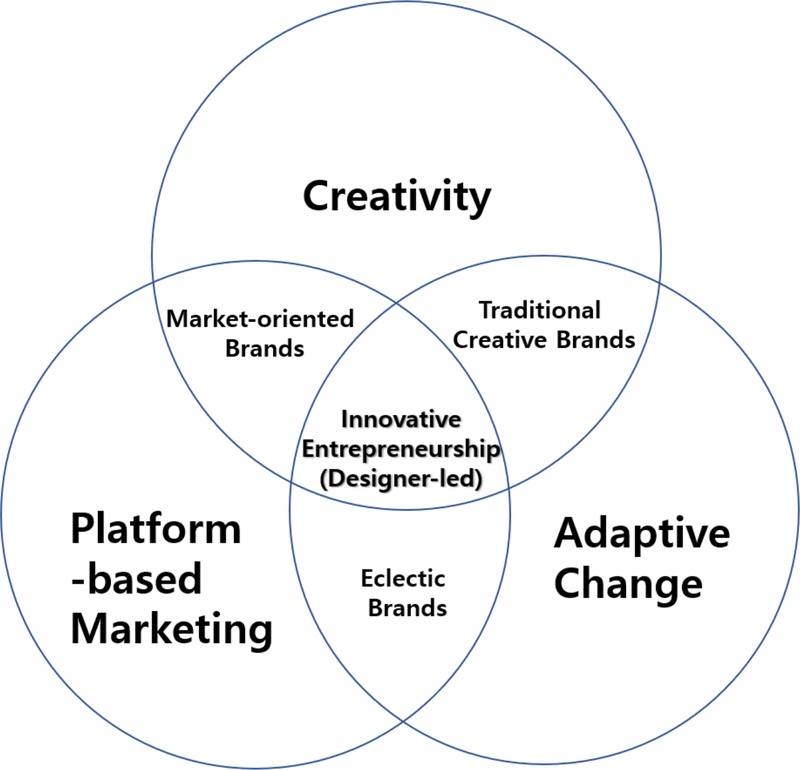
Innovative Business Model Framework for Young Korean Designer Brands
Each dimension corresponds to one of the primary analytical axes identified in the study. Creative authorship captures the degree of design led identity and conceptual coherence; platform-based communication reflects the extent to which brands rely on digital platforms for visibility, engagement, and sales; and adaptive production refers to the flexibility of production systems in response to market demand and resource constraints.
The positioning of each brand type within the model is based on dominant patterns observed across cases. Traditional creative brands are positioned with high creative authorship but relatively low platform dependency and adaptive scalability. Market oriented brands exhibit strong platform reliance and high adaptability, but comparatively lower emphasis on singular creative authorship. Eclectic brands occupy an intermediate position, integrating elements of both creative distinctiveness and market responsiveness.
Importantly, the framework extends beyond a descriptive business model by illustrating how design related elements such as visual identity, product structure, and collection logic are structurally connected to market value through platform mediated communication and production strategies. In this sense, the model contributes to fashion design research by reframing design not only as a formal outcome, but as an integral component of entrepreneurial systems within digitally mediated cultural markets.
Beyond industry level implications, this study also offers insights into the design related strategies of contemporary Korean designer brands. While the analysis does not focus on formal design development processes, the findings reveal that visual identity and product structure are closely intertwined with entrepreneurial and platform-based strategies.
Specifically, traditional creative brands maintain strong visual coherence through sculptural silhouettes, material experimentation, and collection-based composition, reinforcing artistic authorship. In contrast, market-oriented brands construct visual identity through repeatable item structures, trend-responsive styling, and platform optimized imagery, where design operates as a communicative interface aligned with digital consumption. Eclectic brands integrate these approaches, combining distinctive visual elements with commercially adaptable product systems, resulting in hybrid design strategies.
These findings suggest that, in contemporary fashion contexts, design can no longer be understood solely as formal or aesthetic output, but must be considered as part of a broader system linking creative practice, brand identity, and market interaction. This perspective provides implications for fashion design education, emphasizing the need to develop not only formal design skills but also the ability to translate design concepts into coherent brand narratives within platformized cultural environments.
2. Competencies and Policy Implications
The results further suggest that the role of the fashion designer has expanded significantly. Beyond design expertise, future fashion entrepreneurs must possess competencies in digital communication, platform literacy, financial management, supply chain coordination, and cross cultural branding. The ability to interpret platform analytics, engage fandom communities, and translate cultural narratives into globally resonant brand identities has become a core professional requirement rather than a supplementary skill. From a policy perspective, these findings underscore the need to recalibrate existing support systems for designer fashion. Rather thana focusing exclusively on large scale production or export volume, policy interventions should prioritize targeted support for prototyping, small batch and on-demand manufacturing, intellectual property protection, and digital marketing infrastructure. In addition, programs that facilitate access to global platforms, international pop-up exhibitions, and B2B matchmaking can help bridge the gap between cultural visibility and market conversion.
Importantly, the sustainability of the K-fashion ecosystem depends on recognizing young designer brands not as peripheral creative actors but as central agents of industrial innovation. By supporting designer-led micro enterprises as hybrid cultural and economic entities, policy frameworks can foster long term resilience and diversify the global representation of Korean fashion beyond a limited number of flagship brands. Importantly, these competencies are not abstract skill sets but empirically derived requirements emerging from the operational realities of young Korean designer brands identified in this study. The concentration of creative, managerial, and communicative roles within individual designers underscores the need for educational and policy frameworks that address entrepreneurial sustainability alongside creative excellence.
Ⅵ. Conclusion
This study examines how young Korean designer brands reconfigure value creation processes within platformized cultural markets and proposes a typology of entrepreneurial business models. It demonstrates the transformative role of young Korean fashion designers in reshaping the contemporary fashion industry through entrepreneurial practices embedded in digital platforms, fandom-based consumption, and flexible production systems. Moving beyond conventional views of K-fashion as an extension of K-pop and K-drama aesthetics, the findings show that these brands operate within a distinct platform-based ecosystem. Rather than functioning as peripheral creative actors, these designers actively reorganize how fashion value is produced, communicated, and converted into market performance under conditions of global uncertainty.
By classifying young Korean designer brands into three typologies traditional creative, market oriented, and eclectic this study contributes to the literature on fashion entrepreneurship and cultural industries by articulating differentiated pathways through which creativity and commerce are integrated. Importantly, the results indicate that resilience in the Korean fashion sector does not emerge from convergence toward a single dominant business model or scale driven standardization. Instead, it arises from the coexistence of multiple entrepreneurial logics that strategically recombine creative authorship, platform engagement, and adaptive production according to distinct value priorities.
From a theoretical perspective, this research extends discussions of cultural entrepreneurship by foregrounding the designer as an entrepreneurial orchestrator who simultaneously manages aesthetic authorship, digital communication, and business coordination. In doing so, it reframes the role of the fashion designer from an autonomous creative producer to a hybrid cultural economic actor operating within platformized cultural markets. Empirically, the study advances prior research on emerging Korean designers by incorporating recent industry data and original brand level analysis, thereby capturing post pandemic shifts toward platform dependency, fandom engagement, and direct-to-consumer strategies that have not been sufficiently addressed in earlier studies.
The findings also yield important practical implications. For policy makers and industry stakeholders, sustaining the K-fashion ecosystem requires moving beyond export volume–oriented strategies toward targeted interventions that strengthen prototyping capacity, small batch and on demand production, intellectual property protection, and access to global digital platforms. For fashion education, the results underscore the necessity of equipping future designers with entrepreneurial, digital, and cross-cultural competencies alongside creative skills, reflecting the expanded professional role demanded by platform mediated fashion markets.
Importantly, the platformized value conversion mechanisms identified in this study do not produce a single optimal business model. Instead, they generate differentiated strategic configurations among young Korean designer brands. As demonstrated in the Results section, traditional creative designer brands prioritize symbolic capital and artistic legitimacy while engaging selectively with platforms; market oriented designer brands maximize platform dependency and fandom activation to accelerate scalability; and eclectic designer brands strategically balance creative identity with market responsiveness. These typologies illustrate how designers navigate the same platformized cultural environment through distinct entrepreneurial strategies, reinforcing the argument that innovation in K-fashion is configurational rather than uniform.
Despite its contributions, this study has limitations. The brand sample, while analytically robust, is limited to Korean designer brands operating within a specific time frame. Future research could extend this framework through comparative analysis across East Asian or global fashion ecosystems, as well as longitudinal studies examining how designer brands transition between typologies over time. Nevertheless, this research positions young Korean designer brands as central agents of innovation within the global fashion landscape. By clarifying how creativity, entrepreneurship, and digital culture intersect in K-fashion, the study provides a conceptual and empirical foundation for future scholarly inquiry and strategic action aimed at sustaining the global relevance of Korean fashion in an increasingly platform driven and volatile industry environment.
Acknowledgments
This work was supported by the PNU Pre-BK Pilot Program, Pusan National University, 2026.
References
-
Abidin, C. (2016). Visibility labour: Engaging with influencers’ fashion brands and #OOTD advertorial campaigns. Media International Australia, 161(1), 86–100.
[https://doi.org/10.1177/1329878X16665177]

-
Arvidsson, A., & Bonini, T. (2015). Valuing audience passions: From smythe to tarde. European Journal of Cultural Studies, 18(2), 158–173.
[https://doi.org/10.1177/1367549414563297]
-
Aspers, P., & Godart, F. (2013). Sociology of fashion: Order and change. Annual Review of Sociology, 39, 171–192.
[https://doi.org/10.1146/annurev-soc-071811-145526]
- Bourdieu, P. (1993). The field of cultural production. Columbia University Press.
- Crane, D. (2012). Fashion and its social agendas: Class, gender, and identity in clothing (2nd ed.). University of Chicago Press.
-
DeLong, M. (2015). The emerging Korean designer in the South Korean fashion industry: Interview with Yoon Kyung Lee. Fashion Practice, 7(2), 267–282.
[https://doi.org/10.1080/17569370.2015.1045315]
- Duffy, B. E., & Hund, E. (2019). Gendered visibility on social media: Navigating Instagram’s authenticity bind. International Journal of Communication, 13, 4983–5002.
-
Entwistle, J. (2009). The aesthetic economy of fashion: Markets and value in clothing and modelling. Berg.
[https://doi.org/10.2752/9780857854148]
-
Fillis, I., & Rentschler, R. (2010). The role of creativity in entrepreneurship. Journal of Enterprising Culture, 18(1), 49–81.
[https://doi.org/10.1142/S0218495810000501]
-
Helmond, A. (2015). The platformization of the web: Making web data platform ready. Social Media + Society, 1(2).
[https://doi.org/10.1177/2056305115603080]
- Jenkins, H. (2006). Convergence culture: Where old and new media collide. New York University Press.
-
Jin, D. Y. (2016). New Korean Wave: Transnational cultural power in the age of social media. University of Illinois Press.
[https://doi.org/10.5406/illinois/9780252039973.001.0001]
- Khajeheian, D. (2020). Platform entrepreneurship: Conceptualizing the intersection of digital platforms and entrepreneurship. Nordic Journal of Media Management, 1(4), 457–472.
- Korea Creative Content Agency. (2025). 2024 designer fashion industry status survey (KOCCA Research Report No. 24-53). https://library.kocca.kr/detailview.do?MASTER_ID=7522332&action=detailView&menuPath=newBookSESearch&pageIndex=1&searchSubId=0
-
Kwon, S.-H., & Kim, J. (2014). The cultural industry policies of the Korean government and the Korean Wave. International Journal of Cultural Policy, 20(4), 422–439.
[https://doi.org/10.1080/10286632.2013.829052]
-
Lounsbury, M., & Glynn, M. A. (2001). Cultural entrepreneurship: Stories, legitimacy, and the acquisition of resources. Strategic Management Journal, 22(6–7), 545–564.
[https://doi.org/10.1002/smj.188]
- McKinsey & Company. (2026). The state of fashion 2026. https://www.mckinsey.com/industries/retail/our-insights/state-of-fashion
-
Nieborg, D. B., & Poell, T. (2018). The platformization of cultural production. Social Media + Society, 4(3).
[https://doi.org/10.1177/1461444818769694]
-
Nixon, S., & Crewe, B. (2004). Pleasure at work? Gender, consumption and work-based identities in the creative industries. Consumption Markets & Culture, 7(2), 129–147.
[https://doi.org/10.1080/1025386042000246197]
- Oh, I., & Park, G.-S. (2012). From B2C to B2B: Selling Korean pop music in the age of social media. Korea Observer, 43(3), 365–397.
-
Rae, D. (2007). Entrepreneurship: From opportunity to action. Palgrave Macmillan.
[https://doi.org/10.1007/978-0-230-20925-1_4]
-
Scott, M. (2012). Cultural entrepreneurs, cultural entrepreneurship: Music producers mobilising and converting Bourdieu’s alternative capitals. Poetics, 40(3), 237–255.
[https://doi.org/10.1016/j.poetic.2012.03.002]
-
Swedberg, R. (2006). The cultural entrepreneur and the creative industries: Beginning in Vienna. Journal of Cultural Economics, 30(4), 243–261.
[https://doi.org/10.1007/s10824-006-9016-5]
- Yin, R. K. (2018). Case study research and applications: Design and methods (6th ed.). Sage Publications.